Dr Claire Bennett – Being A Type 1 Diabetic Researcher
Today is World Diabetes Day. For many, this just another day, but for me, this is an important day of reflection – writes Dr Claire Bennett.
I was diagnosed as a Type 1 diabetic 14 years ago. I was 33 and had just started my PhD. After losing two stone in two days I knew something wasn’t right. Although I had all the symptoms of Type 1 diabetes I had completely dismissed this. Afterall, I wasn’t a child and there was no history of Type 1 in my family. This was a big mistake and the first of many myths I have seemed to pick up over the years.
My body was in DKA (diabetic ketoacidosis). I was struggling to walk and keep my eyes open. I later learnt if I hadn’t gone to hospital then, I would have been in a coma. This is why learning the symptoms and learning about Type 1 diabetes is important.
Most diabetics have Type 2 diabetes. In the UK for example, about 90% of people with diabetes are Type 2. Consequently, a lot of knowledge people have about diabetes relates to Type 2. However, Type 1 diabetes remains without a known cause or cure and myths and misinformation about the condition continue to exist.
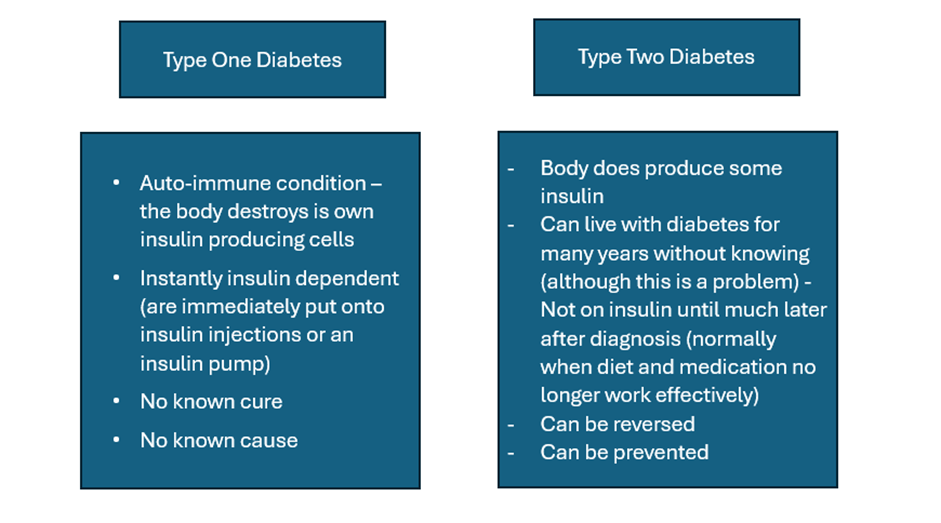
Type 1 & Type 2 Diabetes
There are a number of key differences between the two conditions:
The key thing to remember is Type 1 is an auto-immune condition.
It can affect anyone at any age. It is now not uncommon for people to be diagnosed in the 30s, 40s, 50s and 60s+. Diagnosis can feel very daunting and scary and there is little advice on how to manage it. It is something you have to learn yourself as everybody is different and the insulin you need varies. You have to learn to think and act like your pancreas, which is harder than it sounds. It is a condition which, for me, is mentally and physically exhausting.
However, I feel very lucky in many ways.
I feel lucky I was diagnosed later in life when the pull of fitting in and peer pressure had passed.
I feel lucky that I have access to a closed glucose monitor (CGM) and on a insulin pump, both available through the NHS.
I feel lucky that I am now in an organisation – M·E·L Research – which is disability confident and offers me flexibility when I need to step out to respond to low or high blood sugars. Colleagues try to avoid lunch time meetings with me as they know how important eating by a certain time is. I’m grateful because not every organisation is as accommodating.
You can live a relatively ‘normal’ life with Type 1, we just need flexibility.
It is estimated that on average a Type 1 diabetic makes at least 150 daily decisions connected to their diabetes. So having some awareness of the impact goes a long way.
That said, I still dream that one day a cure will be found, to help take the burden and burnout away. Breathrough T1D have produced a brilliant video of what a cure would feel like. For me, watching this was very emotional as it captured my feelings exactly. Just a bit of peace.
Please watch and share the video, and help raise awareness of impact of living with Type one diabetes.
Claire is an Associate Director in our qualitative research team. The team are currently working with Breakthrough T1D to understand the experiences of adults living with Type 1 diabetes.
M·E·L Research is pleased to welcome four new colleagues to our growing team, strengthening our research and evaluation expertise as we continue to expand our services and support clients.
The appointments of Laura Karban, Associate Director; Bethan Jewsbury, Senior Evaluation Managers; and Chloe Parker, Research Manager, alongside Rhoslyn Davies, who joins us on a short-term basis to provide additional senior evaluation support, bring a wealth of experience across social research, evaluation, public policy…
It was an absolute honour to attend the Women’s Health Conference in London this week, bringing together clinicians, policymakers, campaigners and others passionate about improving women’s health.
As a researcher specialising in women’s health social research, I was excited to have the opportunity to learn, be challenged and exchange ideas with people who share that passion. And I wasn’t disappointed.
There has (quite rightly) been a lot of discussion recently about the gender health gap. But some of the evidence shared…
We are pleased to be working with the MS Society on new health and care social research exploring how health and care services can better support people with multiple sclerosis (MS) and help reduce avoidable hospital admissions.
The health and care social research study will focus on opportunities for earlier intervention and more coordinated, preventative support, while recognising that hospital admission is sometimes clinically necessary. It will…
Last week, I had the opportunity to speak at Collections Inside & Out, a symposium hosted at National Trust Chirk Castle & Garden, bringing together people working across gardens, horticulture, heritage, collections and interpretation.
I was, perhaps, a slight interloper among so many people with deep horticultural expertise but every presentation was incredibly interesting and I learned a lot – and broadly managed to follow the general flow of what was being said (still not 100% au fait with taxa…
We’re pleased to share that our Commercial Director, Elliot Simmonds, will be speaking at the Collections Inside & Out symposium at National Trust Chirk Castle & Garden on 24 September 2026. Bringing together professionals working across heritage collections, gardens and landscapes, the symposium will explore the relationship between indoor and outdoor heritage and the opportunities created by thinking about them as part of a connected visitor experience.
Elliot’s session, “Integrating Indoor…
M·E·L Research has been named the winner of the Award for Outstanding Contribution to Social Value & Ethical Research 2026 at the UK Enterprise Awards.
The award recognises the values that shape both the work we choose to undertake and the way we deliver it. From building trauma-informed practices into our research to improving inclusion and reinvesting in the communities around us, social responsibility is part of how we operate every day.
M·E·L Research joined the British Dyslexia Association (BDA) at the House of Lords this week for the launch of a new report exploring the experiences of dyslexic young people who are not in employment, education or training (NEET).
Tamsin Maries, Senior Research Manager, and Elliot Simmonds, Commercial Manager, represented M·E·L Research at the event…
New UK-wide research from M·E·L Research’s SPARK report shows improving mental health indicators alongside continuing exposure to suicide, widespread lifetime suicidal thoughts and significant gaps in practical knowledge.
Suicide prevention depends on understanding not only how many people are affected, but also how confident the public feel about recognising risk, starting difficult conversations and finding appropriate support. The Spring 2026 SPARK report from M·E·L Research brings these issues together, providing a detailed picture of attitudes…