World Suicide Prevention Day: Our Work with The Jordan Legacy
Please note, this article contains discussion of suicide and statistics relating to suicide.
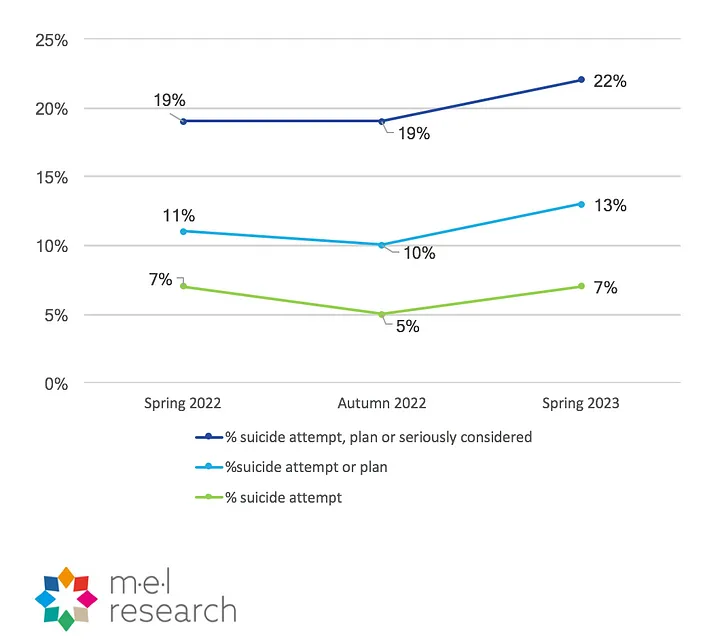
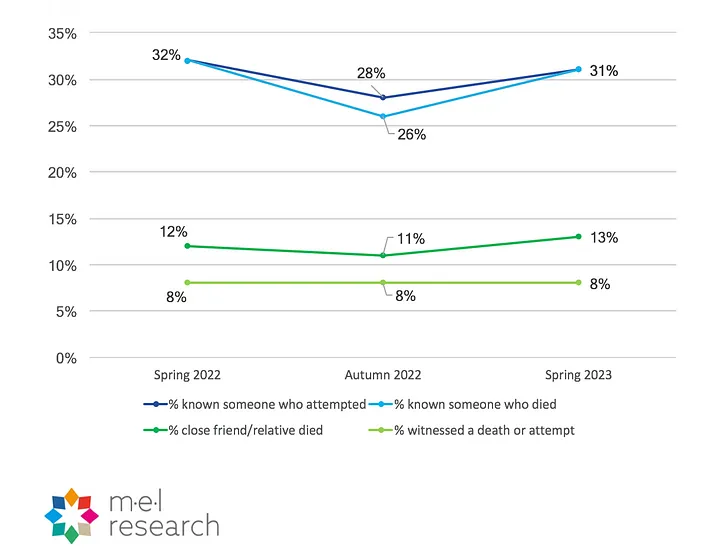
As we approach the fourth wave of the The Jordan Legacy/M·E·L Research Survey, tracking the prevalance of exposure to suicide, suicidal thoughts and self-harming across a sample of n=1500 16+ year olds in the UK, it’s difficult to reflect on the fact that a shocking 1 in 15 adults in the UK has attempted suicide, while 1 in 3 has known someone who died by suicide, and 1 in 8 has lost a close friend or family member to suicide.
With three waves of research having been undertaken, and consistent results across a total sample of n=4500 (1500 per wave), this post discusses some of the findings, as well as some of the feedback we have had from TJL – and some of the actions they would like people to consider.
Before moving on, it is important to note that The Jordan Legacy are just one of a number of suicide prevention, awareness and mental health organisations M·E·L Research work with, including Samaritans, Mind and the Mental Health Foundation, among others. We are grateful for the work that all of these organisations do, particularly to the teams working directly with individuals who need support, and look forward to a day when that work becomes unneccesary.
The need for data
One of the primary reasons The Jordan Legacy CIC chose to partner with M·E·L Research was the glaring gap in the data related to suicide prevention in the UK.
Key statistics were either unavailable or severely outdated, revealing a disconcerting lack of continuous monitoring of critical measures. This situation sheds light on the unfortunate reality that suicide prevention has not been given the priority it deserves. The Jordan Legacy team have reported still frequently hearing statistics from as far back as 2014 or even 2007 being cited.
Thus, our survey was initiated to bridge the data gaps and provide a comprehensive understanding of the current landscape of suicide in the UK.
As we share this information around #WorldSuicidePreventionDay 2023, we not only present some of the survey results but also provide context for the survey and The Jordan Legacy’s action research project. Their aim, and one we are doing what we can to support, is to reduce the alarming suicide rates in the UK and strive towards a ‘Zero Suicide Society.’
It’s crucial to remember that when we discuss ‘suicide numbers,’ we are not merely dealing with statistics; we are confronting human tragedy. Each of the 6,000+ annual suicide deaths over the past 15 years represents an individual person with a life, a family, friends and the loss of their life leaves a lasting impact on the lives of those left behind. It’s also crucial to remember that these deaths are preventable.
Prevalence
The results from The Jordan Legacy/MEL Research Survey reveal the extent of the challenge ahead. As noted above, 1 in 15 adults in the UK has attempted suicide, while 1 in 3 has known someone who died by suicide, and 1 in 8 has lost a close friend or family member to suicide.
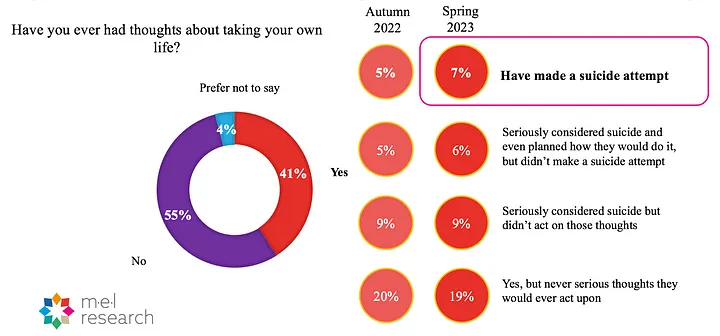
We also ask a very direct question: “Have you ever had thoughts about taking your own life?”
According to findings from the Spring 2023 Survey, 41% of respondents have reported doing so, with around a fifth having atleast seriously contemplated it. Approximately 1 in eight people have taken some form of action either by planning how they would take their own life (6%) or actually attempting suicide (7%).
Feedback from TJL is that on dissemination of these findings, some individuals are surprised to learn that 7% of those aged 16 and above in the UK admit to having attempted suicide. However, this percentage aligns with the data recorded in the Adult Psychiatric Morbidity Survey of 2014, which was previously referenced. This survey, with a random probability sample of 7,500 participants and meticulously designed weighting to ensure full representativeness of the English population, also included an anonymised self-completion segment to assess any potential under-reporting (which was found to be absent).
Action
In the latest survey for which data is available, Spring 2023, 1 in 5 said they had experienced “mental health issues that needed treatment or support”.
Note that we ask in plain English, if they have had “mental health issues that needed treatment or support”.
Also note this doesn’t mean they got the treatment or support they needed, that’s another issue altogether! We know that many don’t seek the support they need or cannot get access to the support they need.
With context, it is perhaps less surprising that a staggering 2 in 3 UK adults have been exposed to suicide in some way, whether through losing someone to suicide, knowing someone who has died by suicide, or witnessing a suicide attempt.
However, a major challenge is that we do not have anywhere near two thirds of people openly discussing this issue. This is one of the changes that Steve Phillip, Paul Vittles and the wider The Jordan Legacy team are trying to make – through deliving talks and webinars, as well as supporting larger scale events such as the Baton of Hope which has recently taken place in the UK and their petition for a Zero Suicide Act.
They also recently delivered a report, titled ‘Moving Towards a Zero Suicide Society,’ outlining a proposed path forward. It details practical actions that individuals can take, including undergoing free Zero Suicide Alliance training to equip themselves with the basic competence and confidence to engage in ‘a conversation that can save a life.’
If you need help or support, the contact details for a range of providers are available below. All participants in our survey are provided with similar signposting as part of their survey experience.
M·E·L Research is pleased to welcome four new colleagues to our growing team, strengthening our research and evaluation expertise as we continue to expand our services and support clients.
The appointments of Laura Karban, Associate Director; Bethan Jewsbury, Senior Evaluation Managers; and Chloe Parker, Research Manager, alongside Rhoslyn Davies, who joins us on a short-term basis to provide additional senior evaluation support, bring a wealth of experience across social research, evaluation, public policy…
It was an absolute honour to attend the Women’s Health Conference in London this week, bringing together clinicians, policymakers, campaigners and others passionate about improving women’s health.
As a researcher specialising in women’s health social research, I was excited to have the opportunity to learn, be challenged and exchange ideas with people who share that passion. And I wasn’t disappointed.
There has (quite rightly) been a lot of discussion recently about the gender health gap. But some of the evidence shared…
We are pleased to be working with the MS Society on new health and care social research exploring how health and care services can better support people with multiple sclerosis (MS) and help reduce avoidable hospital admissions.
The health and care social research study will focus on opportunities for earlier intervention and more coordinated, preventative support, while recognising that hospital admission is sometimes clinically necessary. It will…
Last week, I had the opportunity to speak at Collections Inside & Out, a symposium hosted at National Trust Chirk Castle & Garden, bringing together people working across gardens, horticulture, heritage, collections and interpretation.
I was, perhaps, a slight interloper among so many people with deep horticultural expertise but every presentation was incredibly interesting and I learned a lot – and broadly managed to follow the general flow of what was being said (still not 100% au fait with taxa…
We’re pleased to share that our Commercial Director, Elliot Simmonds, will be speaking at the Collections Inside & Out symposium at National Trust Chirk Castle & Garden on 24 September 2026. Bringing together professionals working across heritage collections, gardens and landscapes, the symposium will explore the relationship between indoor and outdoor heritage and the opportunities created by thinking about them as part of a connected visitor experience.
Elliot’s session, “Integrating Indoor…
M·E·L Research has been named the winner of the Award for Outstanding Contribution to Social Value & Ethical Research 2026 at the UK Enterprise Awards.
The award recognises the values that shape both the work we choose to undertake and the way we deliver it. From building trauma-informed practices into our research to improving inclusion and reinvesting in the communities around us, social responsibility is part of how we operate every day.
M·E·L Research joined the British Dyslexia Association (BDA) at the House of Lords this week for the launch of a new report exploring the experiences of dyslexic young people who are not in employment, education or training (NEET).
Tamsin Maries, Senior Research Manager, and Elliot Simmonds, Commercial Manager, represented M·E·L Research at the event…
New UK-wide research from M·E·L Research’s SPARK report shows improving mental health indicators alongside continuing exposure to suicide, widespread lifetime suicidal thoughts and significant gaps in practical knowledge.
Suicide prevention depends on understanding not only how many people are affected, but also how confident the public feel about recognising risk, starting difficult conversations and finding appropriate support. The Spring 2026 SPARK report from M·E·L Research brings these issues together, providing a detailed picture of attitudes…