M·E·L Research Publishes Comprehensive Evaluation of the all-Wales Rapid Diagnosis Clinics Programme
We are proud to have published an extensive external evaluation of the Rapid Diagnosis Clinics (RDC) programme, a national initiative overseen by the Wales Cancer Network (WCN). This evaluation assessed the effectiveness and impact of the RDCs, which provide critical diagnostic services for patients presenting with vague symptoms that could indicate cancer.
You can read the full report and executive summary on our website. A short animation video highlighting the key findings can be accessed here.
More information about the programme can also be found on the NHS Wales website.
Background
Launched in December 2020, the RDC programme represents a concerted effort by the WCN in collaboration with all Welsh Health Boards and national bodies such as Digital Health and Care Wales, and Improvement Cymru. The initiative sought to streamline diagnostic pathways, ensuring a holistic, personalised, and rapid diagnosis for patients whose symptoms do not clearly point to a specific type of cancer.
Key Successes
The evaluation highlighted several significant achievements of the RDC programme:
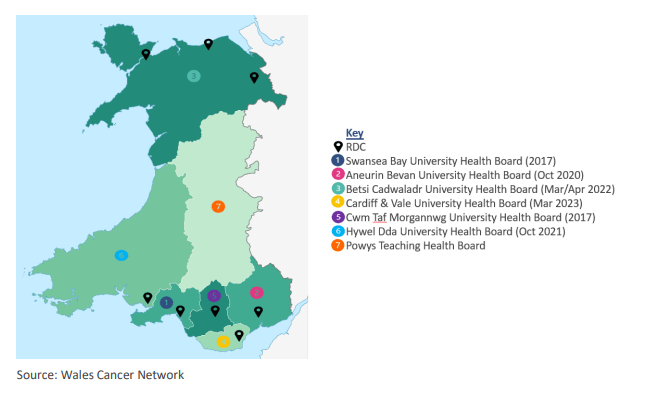
Implementation Across Health Boards: Six Health Boards have successfully implemented RDC services, with referral agreements in place for Powys patients to access neighbouring RDCs.
Job Satisfaction and Communication: There is a high level of job satisfaction among RDC staff. Improved communication and understanding between primary and secondary care providers have been noted.
Increased Awareness and Collaboration: Awareness of RDC services has grown, leading to better working relationships between RDC teams and other secondary care teams. Collaboration and networking among Health Boards and RDC teams have also improved.
Effective Model: The evaluation confirmed that the nationally directed but locally delivered model is effective for implementing an all-Wales programme.
Key Challenges
Despite these successes, the evaluation also identified several challenges:
Referral Quality: There is inconsistency in the quality of referrals, necessitating ongoing communication and education for GPs.
Resource Constraints: The programme faces challenges in serving an increasing patient cohort with limited resources, which can impact the ability to meet the national 7-day diagnostic target.
Funding Uncertainty: There is uncertainty over securing funding to expand the current service.
Data Inconsistencies: Inconsistent data inputs from Health Boards hinder the effectiveness of the national dashboard in assessing the equity of the RDC services across Wales.
Future Considerations
To ensure the sustainability and further development of the RDC programme, the evaluation provided several recommendations:
Mainstreaming and Expansion: Consideration of mainstreaming the service or developing an alternative model such as Community Diagnostic Hubs, incorporating RDCs.
Increased Publicity and Education: More publicity and educational events for GPs, especially face-to-face engagement, to improve referral quality.
Dashboard Review: Reviewing the objectives and key audience of the national dashboard to better suit future evaluation needs.
Socio-Demographic Data Collection: Collecting socio-demographic information across systems to monitor and maintain service equity and quality.
Facilitating Forums: WCN should continue to facilitate forums and meetings to promote cross-pollination and networking among RDC staff.
Conclusion
The evaluation by M·E·L Research underscores the critical role of RDCs in the Welsh healthcare system. The forward planning workshop based on the key findings facilitated discussions on service improvement, future direction and sustainability to continue to enhance RDC services, ensuring timely and accurate diagnoses for patients across Wales, and ultimately to improve cancer care pathways and outcomes for patients with vague symptoms.
How do we demonstrate the true value of culture and heritage? And are we measuring everything that matters?
These were two of the questions that stood out during the third day of the Culture and Heritage Capital: Putting Theory into Practice conference.
Cultural organisations have long recognised that their impact extends beyond visitor numbers, ticket sales and tourism revenue. Museums, heritage sites and cultural programmes can support mental health and wellbeing, strengthen community connections, create opportunities for learning and preserve our shared…
M·E·L Research is pleased to be working with the British Film Institute (BFI) on a three-year evaluation of the BFI Film Academy programme. Since 2012, BFI Film Academy has supported young people to develop skills, confidence, knowledge and networks and explore routes into careers across the screen industries. The refreshed 2026–2029 programme builds on this experience, creating connected pathways from early engagement through to specialist training, mentoring, placements and industry-facing progression, with a strong emphasis on…
M·E·L Research is pleased to welcome four new colleagues to our growing team, strengthening our research and evaluation expertise as we continue to expand our services and support clients.
The appointments of Laura Karban, Associate Director; Bethan Jewsbury, Senior Evaluation Managers; and Chloe Parker, Research Manager, alongside Rhoslyn Davies, who joins us on a short-term basis to provide additional senior evaluation support, bring a wealth of experience across social research, evaluation, public policy…
It was an absolute honour to attend the Women’s Health Conference in London this week, bringing together clinicians, policymakers, campaigners and others passionate about improving women’s health.
As a researcher specialising in women’s health social research, I was excited to have the opportunity to learn, be challenged and exchange ideas with people who share that passion. And I wasn’t disappointed.
There has (quite rightly) been a lot of discussion recently about the gender health gap. But some of the evidence shared…
We are pleased to be working with the MS Society on new health and care social research exploring how health and care services can better support people with multiple sclerosis (MS) and help reduce avoidable hospital admissions.
The health and care social research study will focus on opportunities for earlier intervention and more coordinated, preventative support, while recognising that hospital admission is sometimes clinically necessary. It will…
Last week, I had the opportunity to speak at Collections Inside & Out, a symposium hosted at National Trust Chirk Castle & Garden, bringing together people working across gardens, horticulture, heritage, collections and interpretation.
I was, perhaps, a slight interloper among so many people with deep horticultural expertise but every presentation was incredibly interesting and I learned a lot – and broadly managed to follow the general flow of what was being said (still not 100% au fait with taxa…
We’re pleased to share that our Commercial Director, Elliot Simmonds, will be speaking at the Collections Inside & Out symposium at National Trust Chirk Castle & Garden on 24 September 2026. Bringing together professionals working across heritage collections, gardens and landscapes, the symposium will explore the relationship between indoor and outdoor heritage and the opportunities created by thinking about them as part of a connected visitor experience.
Elliot’s session, “Integrating Indoor…
M·E·L Research has been named the winner of the Award for Outstanding Contribution to Social Value & Ethical Research 2026 at the UK Enterprise Awards.
The award recognises the values that shape both the work we choose to undertake and the way we deliver it. From building trauma-informed practices into our research to improving inclusion and reinvesting in the communities around us, social responsibility is part of how we operate every day.