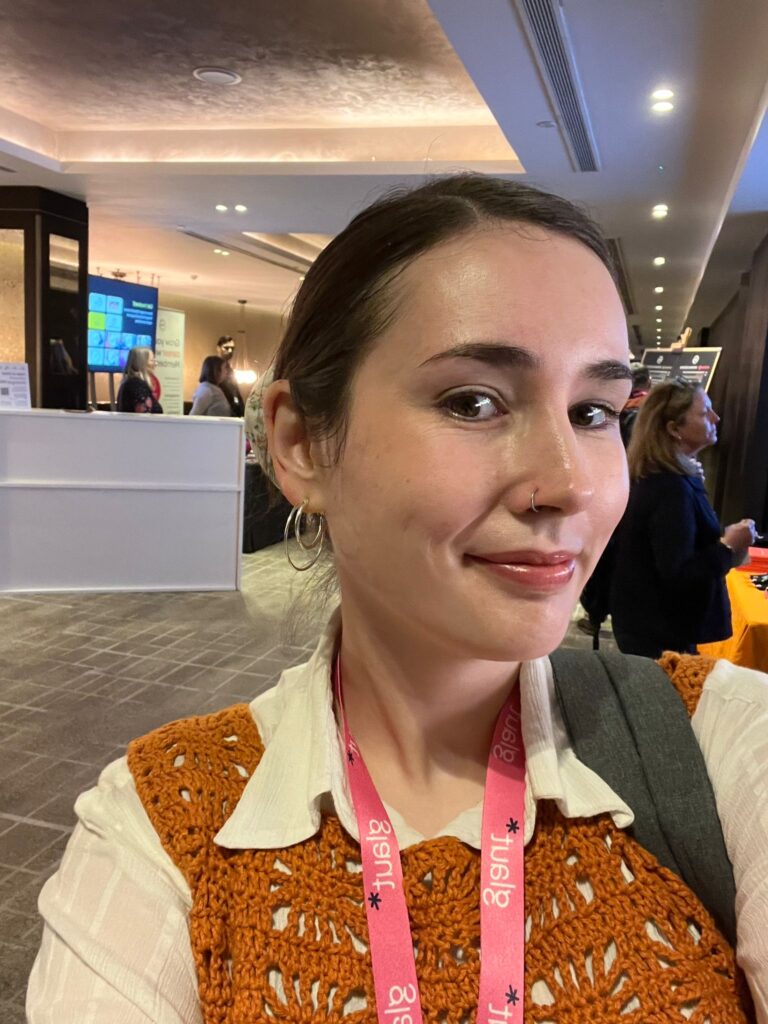
Yesterday, I attended the MRS Conference 2026, where this year’s theme was “Research on the Edge: Building Our Futures.” The event brought together researchers, strategists and industry leaders to explore how insight is evolving in a world shaped by rapid technological change, shifting trust and increasingly complex audiences.
Roisin at the MRS Conference 2026
Across the day’s sessions, several themes came through strongly. AI was a constant presence in the discussion, but so were questions about trust, demographics and the enduring value of human insight.
The worry and the wonder of AI
AI appeared in almost every session throughout the conference.
In the opening plenary, the current decade was described as the “Twitchy 20s”, a period defined by overlapping crises and growing uncertainty. Within that context, AI represents both opportunity and concern. According to Ipsos data, the public is almost evenly split on whether AI will have a positive or negative impact on society.
From a research perspective, the potential benefits are clear. AI can automate repetitive tasks, speed up processes and allow researchers to work more efficiently.
Sinead Jeffries from Zappi spoke about how the growing need for speed is already reshaping how organisations generate insights. She shared the example of PZ Cussons, where traditional research cycles of around six weeks from question to insight were simply too slow in a competitive market.
However, alongside the excitement about efficiency, there were also important questions about what might be lost.
Rebekah Smith from Firefish Research chaired a panel about concerns among junior researchers. Many of the tasks that historically helped early-career researchers learn the craft are now easily automated. If these opportunities disappear, the industry may face a skills gap in the years ahead.
Several speakers returned to the same point. AI can do a significant proportion of the work, but it cannot replace human judgement.
At M·E·L Research, how we nurture the new generation of researchers is something we are actively thinking about. As part of our long-term commitment to developing research talent, we are currently recruiting Insight Executives to join the team. Bringing in and nurturing early-career researchers ensures that the next generation can build the critical thinking, methodological understanding, and client insight that underpin high-quality research.
As Colin Strong from Ipsos put it, AI might be able to complete around 85% of the process, but the real value lies in the final 15%. That is where interpretation, critical thinking and human understanding come into play.
Human insight still matters
The continued importance of human researchers was a recurring message throughout the conference.
Technology can analyse large volumes of information, but it cannot fully understand context, lived experience or cultural nuance. Researchers still play a vital role in interpreting findings, asking better questions and translating data into meaningful stories.
During a panel discussion on communicating in a fractured society, Dex Hunter-Torricke, former communications adviser to Mark Zuckerberg and Elon Musk, spoke about the challenge of navigating a world filled with competing information. With so much data available, the challenge is not simply gathering more information. Instead, it is about identifying the single insight that really matters.
For researchers, that means helping organisations cut through complexity and focus on the findings that can genuinely make a difference.
Rethinking demographics
Another strong theme during the conference was the need to rethink how we segment audiences.
Several sessions questioned whether traditional demographic approaches still provide the understanding we need.
Laura Rowe from OMD UK presented findings from The Farce of Class, a report examining the lived experiences of marginalised communities. She argued that socio-economic group classifications such as SEG have become increasingly outdated.
Historically, class and wealth were closely connected. Today that relationship is far more complex. Occupational measures often fail to reflect people’s real economic circumstances or lifestyles.
Jon Puleston from Ipsos explained that the organisation is currently exploring alternative ways of measuring wealth and social status, with a new framework expected later this year.
The limitations of generational categories were also discussed.
It was also mentioned that Gen Z is treated as a single, homogeneous group, when in reality it is one of the most diverse generations. Instead of focusing purely on age, she suggested looking at people’s motivations and attitudes.
In Appinio’s work with Pladis, researchers identified three key motivations that drive consumer behaviour: power, achievement and affiliation. Combining these motivations with different decision-making styles can provide a much richer understanding of audiences than traditional demographic segmentation alone.
Trust in a fragmented world
Trust was another major theme throughout the conference.
In the opening session, Kelly Beaver shared Ipsos data showing that only 9% of people say they trust politicians to tell the truth, the lowest level recorded in more than four decades.
As trust in traditional institutions declines, people increasingly turn to sources that align with their values.
During the panel discussion, Baroness Mattinson and Dr Elaine Rodrigo from Reckitt spoke about how this shift is leading to more fragmented audiences.
If people lose trust in one source of information, they can easily find another that reflects their views. This creates a more complicated landscape for organisations trying to communicate effectively.
Speakers emphasised that authenticity is critical in this environment. Organisations need to show that they genuinely understand the issues that matter to their audiences, rather than simply responding to trends or social debates without context.
Challenging assumptions about age
Another session focused on how brands think about age and the risks of relying on outdated assumptions.
It was highlighted how marketing strategies often focus heavily on Gen Z while overlooking older audiences.
Yet older consumers account for the majority of spending and will become increasingly important as populations age.
The research also showed that portrayals of older people in advertising frequently rely on stereotypes, depicting them as frail, lonely or disengaged.
In reality, many older people are socially active, technologically confident and exploring new interests later in life.
Successful campaigns increasingly portray older adults socialising across generations, embracing fashion, using technology and engaging in a wide range of activities.
Understanding the gap between attitudes and behaviour
Behavioural science also featured strongly during the conference.
Statistics presented by Lime and Anthony Nolan illustrated why people sometimes behave in ways that conflict with their values.
For example, Lime’s research found that 52% of cyclists in London have run a red light, even though 85% agree that doing so is dangerous. Interestingly, it is often the most experienced cyclists who break the rules.
Anthony Nolan faces a similar challenge. Many people sign up as potential stem cell donors but withdraw once they are matched with a patient.
In both cases, the issue is not awareness but the gap between intentions and actions.
Speakers suggested that timely education and better communication could help bridge this gap. For example, providing safety reminders when cyclists unlock a bike or ensuring people understand the stem cell donation process before signing up.
Looking ahead
The conference closed with a keynote from author and journalist Jon Ronson, who spoke about empathy in an age of polarisation.
Ronson urged us to remain curious and open-minded even when engaging with people whose views feel difficult or uncomfortable.
For researchers, this ability to understand different perspectives is essential.
Reflecting on the day, it was clear that the research industry is entering a period of significant transformation. AI will continue to reshape how we work, but technology alone cannot replace the human skills that underpin meaningful insight.
Curiosity, empathy, storytelling and critical thinking remain at the heart of good research. As the conference theme suggested, the future of research may lie “on the edge”, but it is human understanding that will continue to turn data into insight.
Last week, I had the opportunity to speak at Collections Inside & Out, a symposium hosted at National Trust Chirk Castle & Garden, bringing together people working across gardens, horticulture, heritage, collections and interpretation.
I was, perhaps, a slight interloper among so many people with deep horticultural expertise but every presentation was incredibly interesting and I learned a lot – and broadly managed to follow the general flow of what was being said (still not 100% au fait with taxa…
We’re pleased to share that our Commercial Director, Elliot Simmonds, will be speaking at the Collections Inside & Out symposium at National Trust Chirk Castle & Garden on 24 September 2026. Bringing together professionals working across heritage collections, gardens and landscapes, the symposium will explore the relationship between indoor and outdoor heritage and the opportunities created by thinking about them as part of a connected visitor experience.
Elliot’s session, “Integrating Indoor…
M·E·L Research has been named the winner of the Award for Outstanding Contribution to Social Value & Ethical Research 2026 at the UK Enterprise Awards.
The award recognises the values that shape both the work we choose to undertake and the way we deliver it. From building trauma-informed practices into our research to improving inclusion and reinvesting in the communities around us, social responsibility is part of how we operate every day.
M·E·L Research joined the British Dyslexia Association (BDA) at the House of Lords this week for the launch of a new report exploring the experiences of dyslexic young people who are not in employment, education or training (NEET).
Tamsin Maries, Senior Research Manager, and Elliot Simmonds, Commercial Manager, represented M·E·L Research at the event…
New UK-wide research from M·E·L Research’s SPARK report shows improving mental health indicators alongside continuing exposure to suicide, widespread lifetime suicidal thoughts and significant gaps in practical knowledge.
Suicide prevention depends on understanding not only how many people are affected, but also how confident the public feel about recognising risk, starting difficult conversations and finding appropriate support. The Spring 2026 SPARK report from M·E·L Research brings these issues together, providing a detailed picture of attitudes…
M·E·L Research is pleased to be supporting the Diocese of Manchester with an independent consultation to help inform its future leadership. The research will provide opportunities for people connected with diocesan life, as well as members of the wider community, to share their perspectives on the local context, priorities for the years ahead and the qualities that will be important in future leadership.
Across Europe, we have seen devastating wildfires destroy homes, habitats and communities. They offer us a powerful analogy for how we think about suicide prevention.
When a fire is raging, everything must be done to put it out. Firefighters, emergency services and communities mobilise to save lives. But even when the fire is eventually extinguished, enormous damage may already have been done, and recovery can take years. That is why fire services don’t only fight fires. They also invest in prevention: identifying risks, educating people, installing smoke alarms, creating fire breaks and trying to stop…
My son Jools was 14 years old when he died suddenly in April 2022. There was no note. There was no offline evidence that explained why he died. No one had seen or been aware of any adverse mental health issues, and at his original inquest the coroner could not be sure that Jools was in a suicidal mood. More than four years later, I am still trying to understand what happened to my son. Yet one enormous part of Jools’ life was not properly explored following his death: his digital world. Like almost every teenager, Jools had a life on his phone. Social…