Fertility in the Workplace Research: Statistics, Knowledge Gaps and Workplace Support
Our latest fertility in the workplace research reveals what people know, where the gaps are, and why it matters.
Fertility awareness in the UK remains surprisingly low, despite fertility problems affecting millions of people. Fertility is often framed as a women’s issue. But the reality is that fertility problems can impact men, women and non-binary people. Yet conversation about fertility in the workplace, and the support available in many workplaces, does not always reflect this.
At M·E·L Research, we believe better evidence can help drive more informed conversations and more supportive environments for people experiencing fertility challenges.
To mark International Women’s Day 2026, we partnered with Fertility Network UK on a piece of fertility in the workplace research, to explore public awareness, attitudes and fertility in the workplace support in the UK. Drawing on responses from M·E·L Research’s nationally representative sample of UK adults, the research highlights both significant knowledge gaps and growing public support for better workplace policies.
The findings provide important insights into fertility awareness in the UK, and how society and employers can better support those affected by fertility challenges.
How much does the UK know about fertility problems?
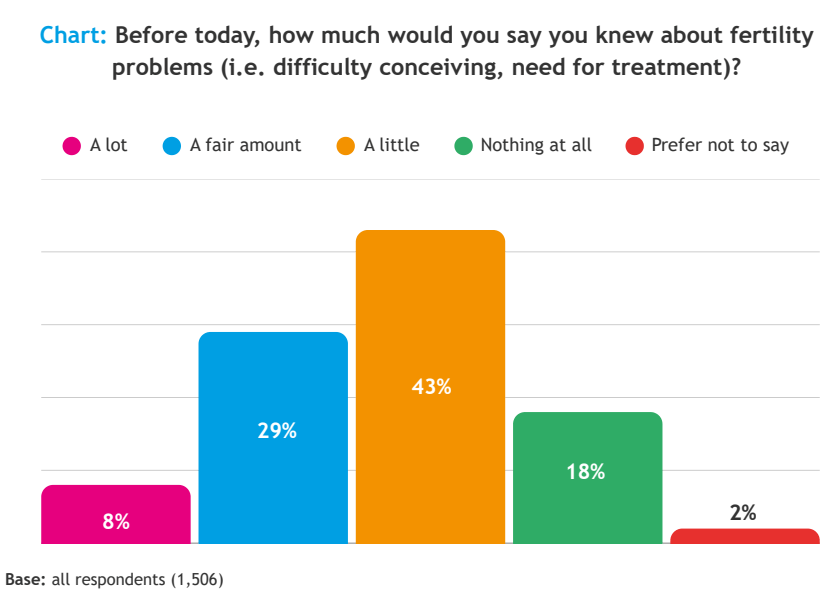
Despite fertility challenges being relatively common, fertility knowledge in the UK remains limited.
Our research found that 61% of people say they know little or nothing about fertility problems. This suggests many people feel they lack reliable information or understanding about fertility and reproductive health.
Awareness also differs significantly between genders. Understanding is lowest among men, with 21% saying they know nothing at all about fertility problems.
These findings highlight how fertility is still often perceived as an issue primarily affecting women, even though fertility challenges can impact people of all genders. Increasing fertility awareness across the population could help create more supportive and informed conversations.
What do fertility statistics reveal about workplace support in the UK?
Fertility challenges can affect people’s professional lives as well as their personal lives.
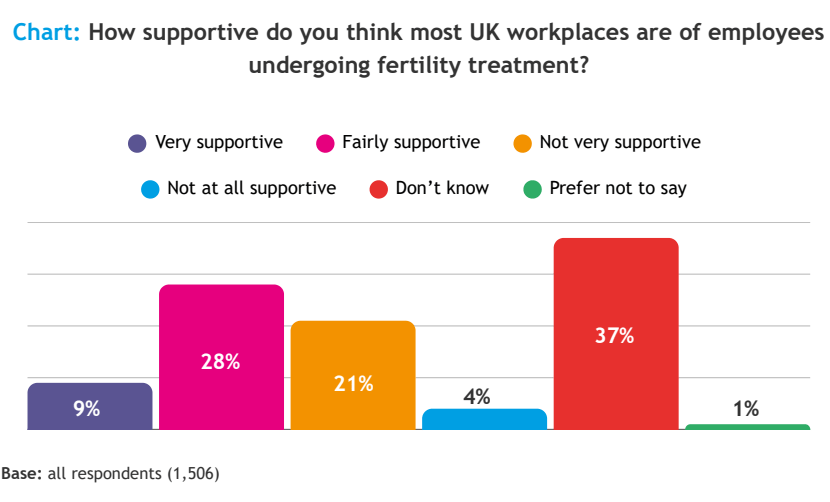
Medical appointments, treatment cycles and the emotional stress associated with fertility difficulties can make balancing work and treatment particularly challenging. However, many workplaces are still not perceived as supportive.
Our research found that only 37% of people believe most UK workplaces are supportive of employees undergoing fertility treatment, and a further 21% said they felt most UK workplaces were not supportive.
These fertility statistics from the UK highlight a gap between the realities many employees face and the policies currently in place in many organisations.
What workplace policies do people support for fertility treatment?
While workplace support may currently be limited, the research suggests that public attitudes are shifting in favour of more supportive policies.
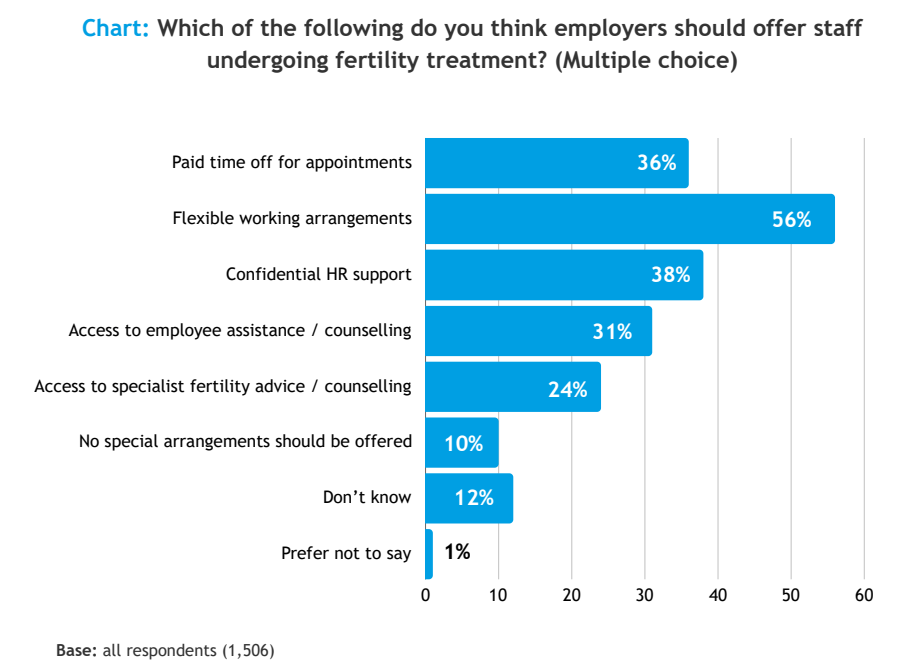
There is strong backing for practical measures that could help employees manage fertility treatment alongside work responsibilities.
For example:
56% support flexible working arrangements for people undergoing fertility treatment
36% support paid time off for fertility-related medical appointments
These findings suggest there is growing recognition that fertility in the workplace deserves greater attention and support.
Flexible policies could help reduce stress for employees while also supporting organisations to retain skilled staff and create more inclusive working environments.
Why does this fertility in the workplace research matter for employers and wider society?
Improving fertility awareness in the UK is important for several reasons.
Limited understanding can contribute to stigma, isolation and a lack of appropriate support for those experiencing fertility challenges. Increasing awareness can help create environments where people feel more comfortable discussing fertility and accessing support.
Greater awareness can also help:
Reduce stigma around fertility difficulties
Encourage open conversations about reproductive health
Support employees undergoing fertility treatment
Improve workplace wellbeing policies
As conversations around health and wellbeing evolve, fertility is becoming an increasingly important part of discussions about inclusive workplaces.
Ruth Gosling, Associate Director and Women’s Health Research Expert at M·E·L Research said of the report:
“Whilst one in six couples are affected by fertility problems, the topic has historically been surrounded by stigma and misunderstanding. Our research points to a positive shift in public attitudes, with growing support for more open discussion, better information, and stronger support for those undergoing fertility treatment. Creating informed, open and supportive environments, both in society and in the workplace, is essential if we are to reduce stigma and ensure that no one faces fertility challenges in isolation. This report aims to contribute to greater awareness and meaningful debate about the future of fertility support in the UK.”
Sharon Martin, CEO of Fertility Network UK said of the research:
“This research is both timely and necessary. The findings highlight encouraging shifts in public attitudes. Most people believe fertility treatment is acceptable. Many support fairer NHS access regardless of relationship status or sexual orientation. There is also clear support for flexible working and paid time off for those undergoing treatment. And yet, significant gaps remain. These insights reinforce what we see every day that openness has improved, but progress is uneven.
Fertility is a health issue. It is a workplace issue. And it is a societal issue. We hope this report sparks meaningful discussion among employers, policymakers and healthcare leaders and, most importantly, drives action. No one should face fertility challenges alone, unsupported, or unheard.”
How can research help improve fertility awareness in the UK?
Research plays an important role in identifying knowledge gaps and shaping public conversations.
This study was developed in partnership with Fertility Network UK, the leading UK charity supporting anyone affected by fertility issues. By combining public opinion research with lived experience and sector expertise, the report contributes valuable insight into how fertility is understood across the UK.
Better data can help inform policy discussions, workplace initiatives and public awareness campaigns aimed at supporting people navigating fertility challenges.
About the research
This fertility awareness research was conducted by M·E·L Research in partnership with Fertility Network UK as part of our omnibus survey exploring public attitudes towards key social and behavioural issues.
The study surveyed a nationally representative sample of UK adults, examining:
Fertility awareness and knowledge levels
Perceptions of workplace support for fertility treatment
Public attitudes towards workplace policies supporting fertility treatment
The findings provide new insights into fertility statistics in the UK and highlight opportunities to improve awareness, workplace support and public understanding.
Need Support With Your Own Social Research?
Whether you’re a public body, charity, or organisation looking to understand your audience, evaluate impact, or inform future strategies, we’re here to help.
Get in touch with the M·E·L Research team today via our ‘Get in touch’ form below to see how our expert researchers can support your goals. Alternatively, you can email the team at info@melresearch.co.uk.
Last week, I had the opportunity to speak at Collections Inside & Out, a symposium hosted at National Trust Chirk Castle & Garden, bringing together people working across gardens, horticulture, heritage, collections and interpretation.
I was, perhaps, a slight interloper among so many people with deep horticultural expertise but every presentation was incredibly interesting and I learned a lot – and broadly managed to follow the general flow of what was being said (still not 100% au fait with taxa…
We’re pleased to share that our Commercial Director, Elliot Simmonds, will be speaking at the Collections Inside & Out symposium at National Trust Chirk Castle & Garden on 24 September 2026. Bringing together professionals working across heritage collections, gardens and landscapes, the symposium will explore the relationship between indoor and outdoor heritage and the opportunities created by thinking about them as part of a connected visitor experience.
Elliot’s session, “Integrating Indoor…
M·E·L Research has been named the winner of the Award for Outstanding Contribution to Social Value & Ethical Research 2026 at the UK Enterprise Awards.
The award recognises the values that shape both the work we choose to undertake and the way we deliver it. From building trauma-informed practices into our research to improving inclusion and reinvesting in the communities around us, social responsibility is part of how we operate every day.
M·E·L Research joined the British Dyslexia Association (BDA) at the House of Lords this week for the launch of a new report exploring the experiences of dyslexic young people who are not in employment, education or training (NEET).
Tamsin Maries, Senior Research Manager, and Elliot Simmonds, Commercial Manager, represented M·E·L Research at the event…
New UK-wide research from M·E·L Research’s SPARK report shows improving mental health indicators alongside continuing exposure to suicide, widespread lifetime suicidal thoughts and significant gaps in practical knowledge.
Suicide prevention depends on understanding not only how many people are affected, but also how confident the public feel about recognising risk, starting difficult conversations and finding appropriate support. The Spring 2026 SPARK report from M·E·L Research brings these issues together, providing a detailed picture of attitudes…
M·E·L Research is pleased to be supporting the Diocese of Manchester with an independent consultation to help inform its future leadership. The research will provide opportunities for people connected with diocesan life, as well as members of the wider community, to share their perspectives on the local context, priorities for the years ahead and the qualities that will be important in future leadership.
Across Europe, we have seen devastating wildfires destroy homes, habitats and communities. They offer us a powerful analogy for how we think about suicide prevention.
When a fire is raging, everything must be done to put it out. Firefighters, emergency services and communities mobilise to save lives. But even when the fire is eventually extinguished, enormous damage may already have been done, and recovery can take years. That is why fire services don’t only fight fires. They also invest in prevention: identifying risks, educating people, installing smoke alarms, creating fire breaks and trying to stop…
My son Jools was 14 years old when he died suddenly in April 2022. There was no note. There was no offline evidence that explained why he died. No one had seen or been aware of any adverse mental health issues, and at his original inquest the coroner could not be sure that Jools was in a suicidal mood. More than four years later, I am still trying to understand what happened to my son. Yet one enormous part of Jools’ life was not properly explored following his death: his digital world. Like almost every teenager, Jools had a life on his phone. Social…