As AI tools become increasingly common in everyday life, many people are already using them to seek information, understand their rights and navigate legal issues.
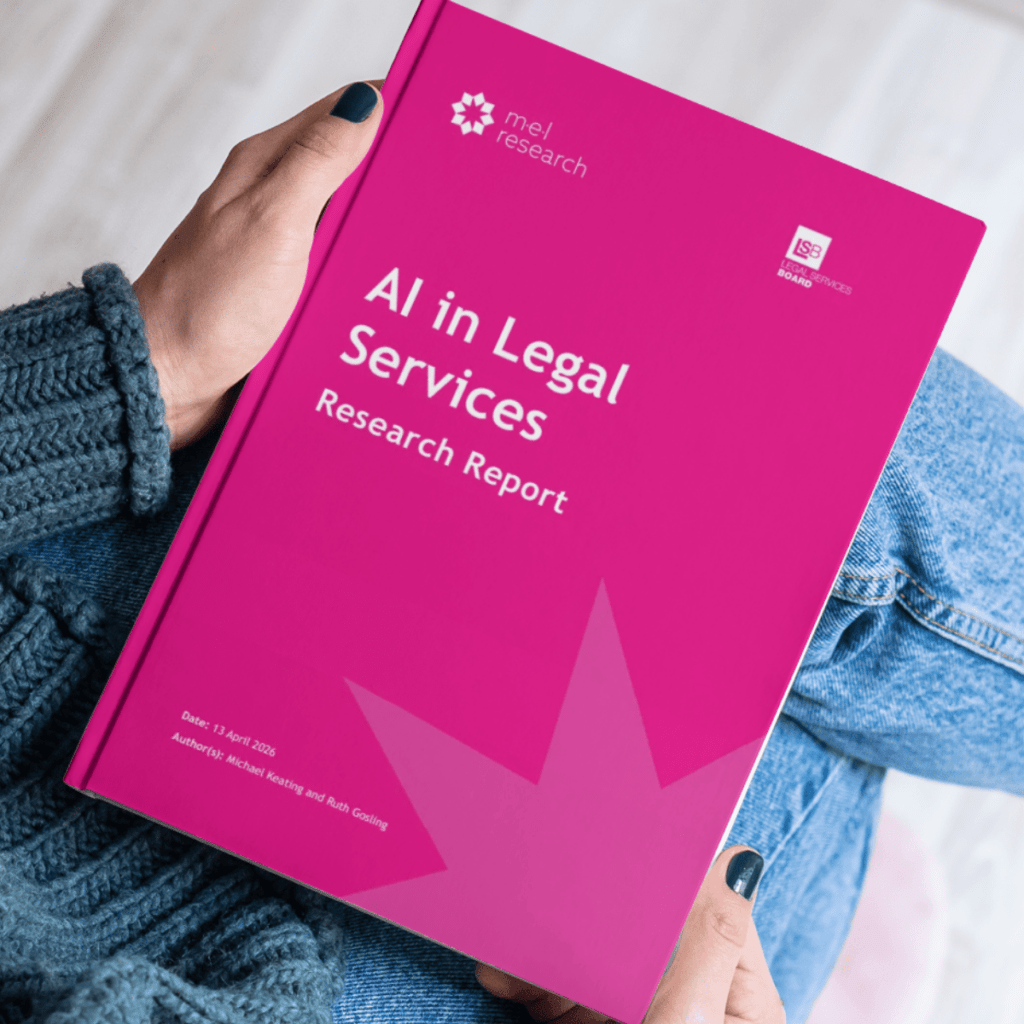
To better understand how consumers feel about these developments, LSB commissioned us to conduct a comprehensive programme of research with legal service users across England and Wales, including deliberative workshops, an online community and a survey of 1,000 adults representative of the population.
The research found that consumers are broadly optimistic about the potential benefits of AI in legal services.
Many believe AI could help make legal services easier to access, more affordable and simpler to use. When asked about the likely impact of AI:
70% expected legal services to become easier to use
66% expected accessibility to improve
64% expected legal services to become more affordable
Consumers also saw potential for AI to help people understand their rights, access information more quickly and overcome some of the barriers that can make legal services difficult to navigate.
What opportunities do consumers see for AI in legal services?
The research found strong support for the idea that AI could improve access to justice.
Participants believed AI-powered tools could help people obtain legal information more easily, explain complex processes in plain language and provide support outside traditional office hours. Many also felt AI could help reduce costs by automating routine tasks and making legal support more widely available.
Consumers were particularly positive about AI’s potential to improve ease of use and affordability, viewing these as areas where technology could deliver meaningful benefits for people who might otherwise struggle to access legal support.
What safeguards do consumers expect from AI-powered legal services?
While consumers were positive about AI’s potential, their support came with clear conditions.
Across all stages of the research, five non-negotiable expectations emerged. Consumers said AI-powered legal services should:
Provide a minimum guarantee of accuracy
Never take consequential action without informed consent
Include an appropriate level of human oversight
Offer access to redress if harm occurs
Protect users’ personal information and safety
These safeguards were viewed not as desirable extras, but as fundamental requirements for building trust in AI-powered legal services.
Why are consumers concerned about AI acting without consent?
One of the strongest findings from the research was the importance consumers place on maintaining control.
Participants were consistently uncomfortable with the idea of AI tools taking action on their behalf without explicit permission, even when those actions might lead to a positive outcome. Concerns around autonomy, consent and accountability emerged repeatedly throughout the research.
Consumers wanted AI tools to support decision-making, not replace it. The expectation that people should remain in control of important legal decisions was one of the clearest themes to emerge from the study.
What does the future of AI in legal services look like?
The research paints a nuanced picture of public attitudes towards AI in legal services.
Consumers recognise the significant opportunities AI presents for improving accessibility, affordability and ease of use. However, they also expect robust safeguards to ensure that innovation does not come at the expense of accuracy, accountability, transparency or consumer protection.
The findings suggest that public confidence in AI-powered legal services will depend not only on what these tools can do, but also on whether consumers feel protected when using them.
We are proud to have supported the Legal Services Board in generating evidence on this rapidly evolving area. As AI continues to reshape legal services, understanding consumer expectations will be essential to ensuring innovation delivers meaningful benefits while maintaining public trust.
Whether you’re a public body, charity, or organisation looking to understand your audience, evaluate impact, or inform future strategies, we’re here to help.
Get in touch with the M·E·L Research team today via our ‘Get in touch’ form below to see how our expert researchers can support your goals. Alternatively, you can email the team at info@melresearch.co.uk.
M·E·L Research is pleased to welcome four new colleagues to our growing team, strengthening our research and evaluation expertise as we continue to expand our services and support clients.
The appointments of Laura Karban, Associate Director; Bethan Jewsbury, Senior Evaluation Managers; and Chloe Parker, Research Manager, alongside Rhoslyn Davies, who joins us on a short-term basis to provide additional senior evaluation support, bring a wealth of experience across social research, evaluation, public policy…
It was an absolute honour to attend the Women’s Health Conference in London this week, bringing together clinicians, policymakers, campaigners and others passionate about improving women’s health.
As a researcher specialising in women’s health social research, I was excited to have the opportunity to learn, be challenged and exchange ideas with people who share that passion. And I wasn’t disappointed.
There has (quite rightly) been a lot of discussion recently about the gender health gap. But some of the evidence shared…
We are pleased to be working with the MS Society on new health and care social research exploring how health and care services can better support people with multiple sclerosis (MS) and help reduce avoidable hospital admissions.
The health and care social research study will focus on opportunities for earlier intervention and more coordinated, preventative support, while recognising that hospital admission is sometimes clinically necessary. It will…
Last week, I had the opportunity to speak at Collections Inside & Out, a symposium hosted at National Trust Chirk Castle & Garden, bringing together people working across gardens, horticulture, heritage, collections and interpretation.
I was, perhaps, a slight interloper among so many people with deep horticultural expertise but every presentation was incredibly interesting and I learned a lot – and broadly managed to follow the general flow of what was being said (still not 100% au fait with taxa…
We’re pleased to share that our Commercial Director, Elliot Simmonds, will be speaking at the Collections Inside & Out symposium at National Trust Chirk Castle & Garden on 24 September 2026. Bringing together professionals working across heritage collections, gardens and landscapes, the symposium will explore the relationship between indoor and outdoor heritage and the opportunities created by thinking about them as part of a connected visitor experience.
Elliot’s session, “Integrating Indoor…
M·E·L Research has been named the winner of the Award for Outstanding Contribution to Social Value & Ethical Research 2026 at the UK Enterprise Awards.
The award recognises the values that shape both the work we choose to undertake and the way we deliver it. From building trauma-informed practices into our research to improving inclusion and reinvesting in the communities around us, social responsibility is part of how we operate every day.
M·E·L Research joined the British Dyslexia Association (BDA) at the House of Lords this week for the launch of a new report exploring the experiences of dyslexic young people who are not in employment, education or training (NEET).
Tamsin Maries, Senior Research Manager, and Elliot Simmonds, Commercial Manager, represented M·E·L Research at the event…
New UK-wide research from M·E·L Research’s SPARK report shows improving mental health indicators alongside continuing exposure to suicide, widespread lifetime suicidal thoughts and significant gaps in practical knowledge.
Suicide prevention depends on understanding not only how many people are affected, but also how confident the public feel about recognising risk, starting difficult conversations and finding appropriate support. The Spring 2026 SPARK report from M·E·L Research brings these issues together, providing a detailed picture of attitudes…