Social Research ¦ Market Research ¦ Behavioural Insight ¦ Evaluation ¦ SROI
Social Research ¦ Market Research ¦ Behavioural Insight ¦ Evaluation ¦ SROI
Elliot Simmonds, our sector lead for Arts, Culture and Natural Heritage, attended Marketing Peak District and Derbyshire’s annual conference in early October, and provides a brief (ish) run-down of the key takeaways below. You can get in touch with Elliot directly to discuss this or any other relevant subject in more detail.
I had the opportunity to attend the Marketing Peak District and Derbyshire annual conference a couple of weeks ago to hear from a range of speakers on the current and future situation of the Peak District’s visitor economy, as well as some more specific highlights coming up in the future.
The session started with an introduction from Managing Director – Jo Dilly – which discussed a range of round tables and progress towards redevelopment of Local Visitor Economy Partnerships powers and the government’s desire to streamline these. This in itself is an interesting on-going development and it’s great to hear that MPD&D are consulting more widely. More specifically, MPD&D has supported a range of positive outcomes this year including:
This introduction was followed by a number of short talks, from which I’ve noted the key highlights below – but I’d encourage anyone interested to reach out to the relevant individuals as there was a lot of information contained!

Rachel talked us through MPD&D’s new brand which seeks to create a more consistent feel across all of the DMO’s various sub-offers. Crucially, it was great to hear that ‘brand is not just an image’ – this is absolutely correct and I really love the new positioning around “visit everything England”, which nicely encapsulates the Peak District – we have everything that England has to offer, in a tightly defined space! Bravo!
It was also a welcome surprise to hear that Tom Cruise felt the same way!
“It is breathtaking and I found myself wanting to explore more and more. That’s the reason I have made a few other visits in my own time that have nothing to do with work.”
Patricia is relatively new in the role but that wasn’t at all evident – there was a lot packed in to this talk. Key takeaways for me were around the international visitor market, which VB are predicting to return to 2019 levels by around 2024, which is a positive, but there is a sense that these are unlikely to be driven as much by China as was previously expected, with this slack picked up by the Middle East and, potentially, India. The weak pound also makes the UK attractive to US visitors currently, so some silver lining…
VB also presented survey figures, which suggest key drivers include flexibility (e.g. around cancellation clauses) and ease of booking as hygiene factors. Differentiators are freedom to roam, value for money and welcome.
The UK scores well on freedom to roam but we are relatively expensive (not withstanding the weak pound) and only middle of the road on perceived welcome – Brexit is a potential driver here, as well as recent comments from the now ex-Home Secretary. Depending on when you read this, this may now be ex- ex- so I’m talking about Suella.
Domestically…
People were very focussed on safety and the cost of travel – this has just flipped towards cost of living, a growing barrier to trip taking.
Overnight spends: people are moving to saving money – cheaper accommodation, cheaper eating out. 12% say they are not going at all, but 22% are not going to change their plans.
Day trips: 34% looking for free stuff, 32% will spend less on eating out, 14% won’t go, 25% will carry on regardless.
Looking to the future, at the time of the conference this was a Govt that had a strong interest in growth, and it was flagged that tourism is an industry that can deliver that quickly – creating additional employment if people come. Given recent backtracking on tax cuts we will have to see what Jeremy Hunt says at the end of October however and whether growth, or austerity, is the driving force.
In terms of our international offer, heritage and history are key in Britain – but this means there is less perceived ‘need to go’ – as those will be the same in ten years. However, there may be a chance to capitalise on upcoming events, such as the Coronation, which are “once in a lifetime” type events.
In my role with MEL we undertake several Quarterly Economic Surveys for Chambers and so, whilst Scott was introduced as the “voice of doom”, what he said wasn’t a huge surprise.
Essentially, most indicators for the EAST Midlands economy were down. You can find a fuller analysis from Scott and the team here as the reports are published: https://www.emc-dnl.co.uk/helping-you-influence/quarterly-economic-survey-qes/qes-reports/
Importantly for the sector however, Scott did highlight the Business Crime Reduction Partnership – a scheme which brings together multiple partners to combat crime and anti-social behaviour and may be of particular interest to tourism businesses. My experience as a Trustee of a rural heritage site suggests this is something that will be welcomed.
What will also be welcomed is continued movement towards an East Midlands Combined Authority, plans for and progress towards which were outlined by Councillor Lewis. An elected Mayor will bring more power and more investment to local people and businesses as well as £1.14bn over 30 years. If the success of places like Liverpool City Region and their visitor economy is anything to go by, this is a positive move.
The Councillor also discussed the development of a “Making It” festival, a flagship programme which will be the corner stone of £1m investment taking place, with the festival itself beginning in Autumn 2023.
Before that, the Shine A Light festival will bring thousands of visitors to a range of sites across the region. This is yet another example of light show style events about which I recently wrote.
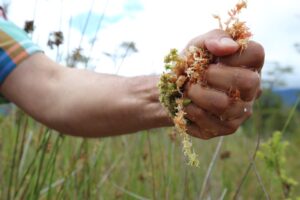
Jenny discussed the work of the Foundation, who deliver a wide range of projects including school engagement, re-wilding, the reintroduction of sphagnum moss to landscapes – this is a “super moss” with incredible carbon capture properties, as well as social prescribing initiatives (e.g. similar to our work with WWT) and programmes such as MOSAIC which work to encourage traditionally underrepresented groups to spend time in the country side.
This final point struck me quite hard as it was something that despite working in the sector and living in the Peak District I’d never given much thought to. Too often images of the countryside are of white people in Barber jackets with a spaniel. We need to do better here.
If you want to find out more about the Foundation, which is supported by but separate from the National Park Authority, a good place to start is their Peak Partners programme.
The penultimate session was from Miles. I have to admit, I was a bit sceptical initially as quarrying and Peak District is often seen as at best a necessary evil.
However, the plans Miles discussed for the redevelopment of National Stone Centre sound like an excellent addition to the area, building not only a visitor destination but also a skills development centre for an important industry. As an Enterprise Advisor at BLC it’s always positive to hear about employers and industries developing centres of excellence. The Centre also has a 100 year design life, taking in to account the fact that it may change in terms of use as time progresses.
Paul delivered a fantastic session on TikTok and other social media channels and how tourism businesses can best utilise these. The focus was very much on short format video, and key takeaways included:
